
What happens when dogs inhale essential oils
One of the questions I’m asked most often in one-to-one sessions is how essential oils can help if a dog is only inhaling them.
For many people, essential oils are most familiar through aromatherapy. In that context, essential oils are commonly blended and applied to the body through massage, skincare, or other topical use. Because of this, it’s easy to assume that for an oil to have any real effect, it needs to be rubbed into the skin or absorbed directly into the body.
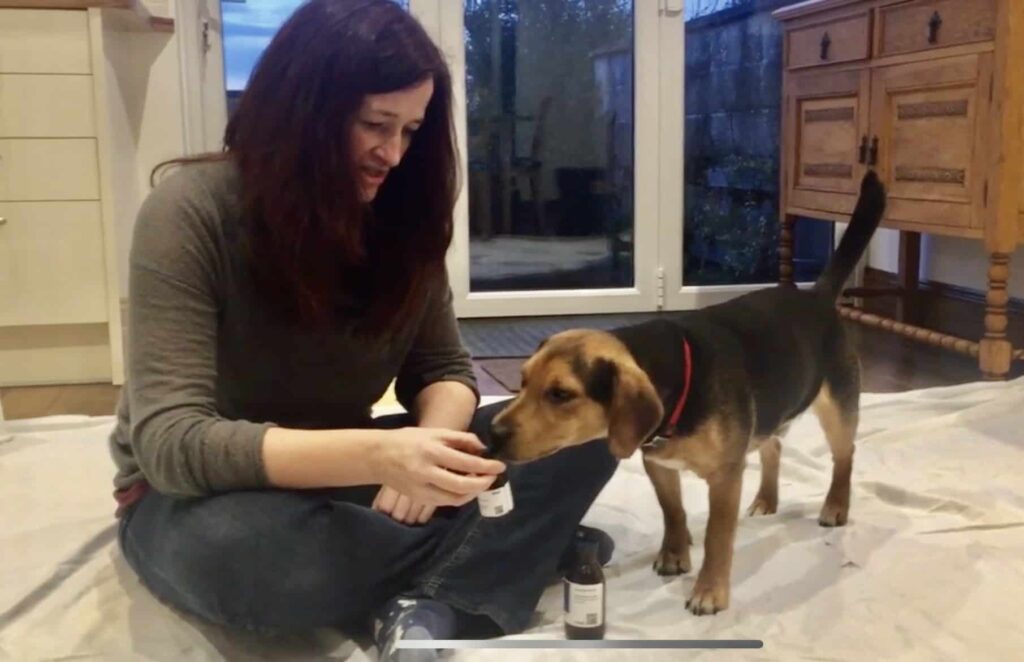
When working with dogs, however, inhalation is often the primary way essential oils are offered and used.
This isn’t because topical use is never appropriate, but because scent is already central to how dogs experience and understand the world.
Scent is how dogs understand their environment
Dogs learn about their surroundings, and about others, largely through their senses. Scent, in particular, is not secondary information. It is fundamental.
Dogs have around 300 million olfactory receptors, compared to our roughly five million, and a large proportion of their brain is devoted to processing smell. Through scent, dogs gather information about where they are, who has been present, what has happened, and even how others may have felt.
As Alexandra Horowitz describes in her work on canine perception, dogs don’t simply smell what is present. They read layers of information through scent, including emotional and contextual traces.
When a dog encounters a smell, their body responds directly. There is no separation between the scent and their experience of it. The scent is the experience.
Why scent can change how a dog feels so quickly
Scent has a direct link to areas of the brain involved in emotion and memory. Because of this, inhaled aromas can alter how a dog feels very quickly, without the dog needing to understand what is happening or interpret it in any way as humans often try to do.
In practice, this is why inhalation can be so supportive for dogs experiencing anxiety, fear, sound sensitivity, or overwhelm. It’s also why aromatics are often helpful around events such as fireworks, travel, veterinary visits, or during end-of-life care.
The scent doesn’t remove the situation. What it can do is change how the dog is experiencing it in their body, helping them feel steadier and less flooded by what’s happening around them.
Inhalation affects the body, not just emotional state
Inhalation isn’t limited to emotional support. There is substantial evidence showing that essential oils can influence physical processes in the body such as heart rate, circulation, digestion, inflammation, pain perception, and microbial activity.
When a dog inhales an essential oil, aromatic molecules stimulate scent receptors connected to parts of the brain involved in autonomic functions. These are the systems that influence breathing, gut movement, immune response, circulation, and stress physiology.
Some aromatic compounds are also absorbed through the lungs and nasal tissues into the bloodstream, allowing inhalation to have effects beyond the nervous system alone.
This helps explain why dogs may be drawn to certain aromatics when they are experiencing physical discomfort, such as pain, internal spasms, digestive disturbance, inflammation, or infection.
Why dogs often choose inhalation
In human aromatherapy, physical issues are often addressed through topical application. With dogs, inhalation is frequently the route they choose first, particularly when they are sore, unwell, or sensitive to handling.
Inhalation allows the dog to engage with aromatic compounds without touch, restraint, or interference with a painful or sensitive area. This can be especially important during illness, injury, or end-of-life care, when physical contact may feel overwhelming.
The changes you observe are often subtle but meaningful. A deeper breath. A softening through the body. Less guarding. More ease in movement. These responses are meaningful, even when the underlying issue remains present.
When dogs ask for more than inhalation
While inhalation is often the primary way dogs engage with essential oils, it isn’t the only route they choose.
Dogs will sometimes clearly ask for topical application. This may look like presenting a particular part of their body, lingering over an area, leaning in, or rolling after contact with an aromatic. These behaviours are forms of communication.
In these moments, the dog is directing the interaction. They are indicating where and how they want the aromatic to be used. When this happens, topical application may feel appropriate and supportive, particularly when the dog is dealing with localised discomfort, muscle tension, or inflammation.
As always, this is done gently, in small amounts, and with ongoing observation. The dog’s response guides whether the interaction continues or stops.
The important point is not the route itself, but that the route is chosen by the dog.
Dogs know how much they need
Dogs don’t approach essential oils with expectations or goals. They respond to how something feels in their body in that moment.
This is why engagement with scent is often brief. A dog may approach, inhale for a short time, and then move away. Sometimes they return later, sometimes they don’t. This isn’t a sign that nothing happened. It usually means enough information has been taken in.
When choice is available, dogs are very good at limiting their own exposure.
A note on how scent works
Scent is often explained through chemistry, using a lock-and-key model where aromatic molecules interact with receptors. There is also research suggesting that vibration or frequency may play a role in how scent is perceived.
From a practical point of view, the exact mechanism matters less than the relationship itself. Plants and dogs evolved alongside one another. The chemistry of plants and the chemistry of canine nervous systems are deeply connected.
In that sense, aromatic molecules aren’t foreign substances. They are part of a long-standing biological conversation.
Why choice matters
Inhalation is most supportive when it is offered as a choice. When a dog can approach, engage, move away, and return if needed, their body remains in control of the interaction.
Continuous diffusion or forced exposure removes that control and can overwhelm rather than support. Subtle access and careful observation matter far more than intensity or duration.
Most of the time, very little is needed.
Closing thoughts
Essential oils don’t need to be applied to the body to have an effect. For dogs, inhalation is often the most direct and relevant pathway.
When scent is offered with choice, dogs show very clearly how they use it. Often that use is brief, precise, and enough to help them cope with whatever they are facing in that moment.
That clarity is something dogs offer us freely, if we’re willing to pay attention.